Comparing works by two women artists of the same age, class and background. producing works on possibly related themes, citing the same influences and neither claiming feminist credentials.
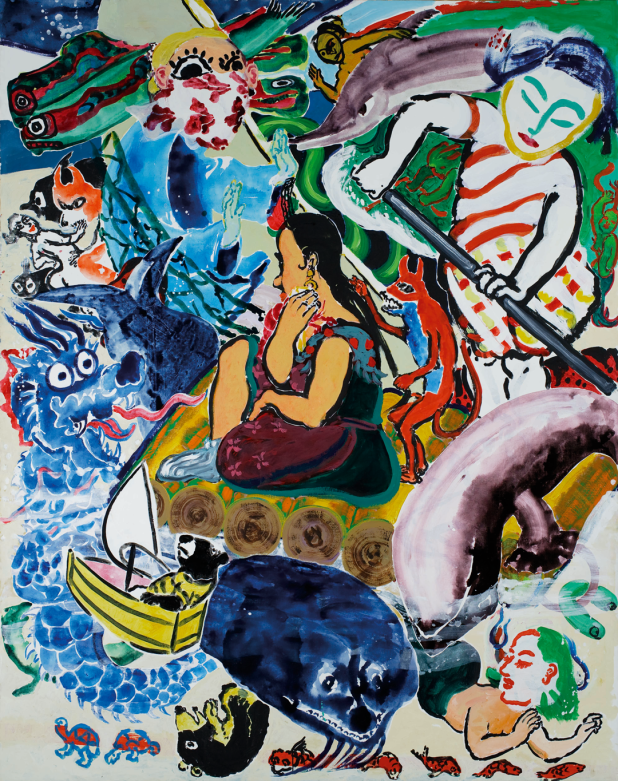
Paula Rego, The Raft, 1985

Rose Wylie, Cuban Scene, 2016
Rose Wylie (1934 – ), Paula Rego (1935 – 2022
Narrative tradtion, mainly figurative. many influences in common (eg neo-expressionists especially Philip Guston), Walt Disney, Dubuffet). My interest here is in comparing the two – raises important questions.
Neo-Expressionism eg Philip Guston, Julian Shnabel, Sigmar Polke, Gerhard Richter, George Baselitz, Anself Kiefer. Reaction against minimalism and conceptual art and focussed on re-shaping figurative drawing and more formal aesthetics.
Rose Wylie is also a narrative painter and could also be said to be working in the neo-expressionist mould. Logical endpoint of modernist abstraction/Picasso? Teleological approach (cf Benjamin)?
Philip Guston – turn from abstract expressionism, works generally thought mad at the time, influenced by Dubuffet.
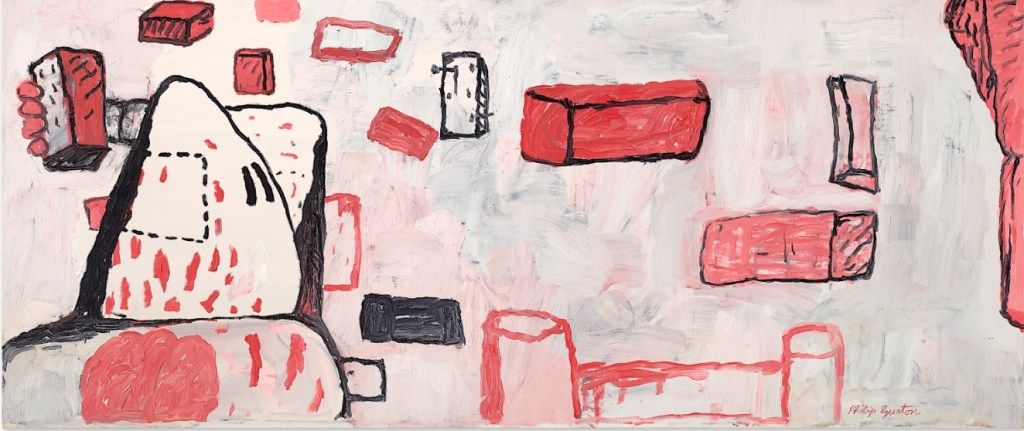
Philip Guston, Bricks, 1970
Art Brut (raw art)/outsider art. Understaood as art outside the accepted, mainstream boundaries, the sort of art produced by non-professionals working outside aesthetic norms, such as art by psychiatric patients, prisoners, and children. Claim that academic art isolating and pretentious. Dubuffet himself highly educated, professionally trained intellectualand, the very opposite of naive. The same could be said of both Rego and Wylie though only Wylie is marketed as a naif. Walt Disney/folk tales.
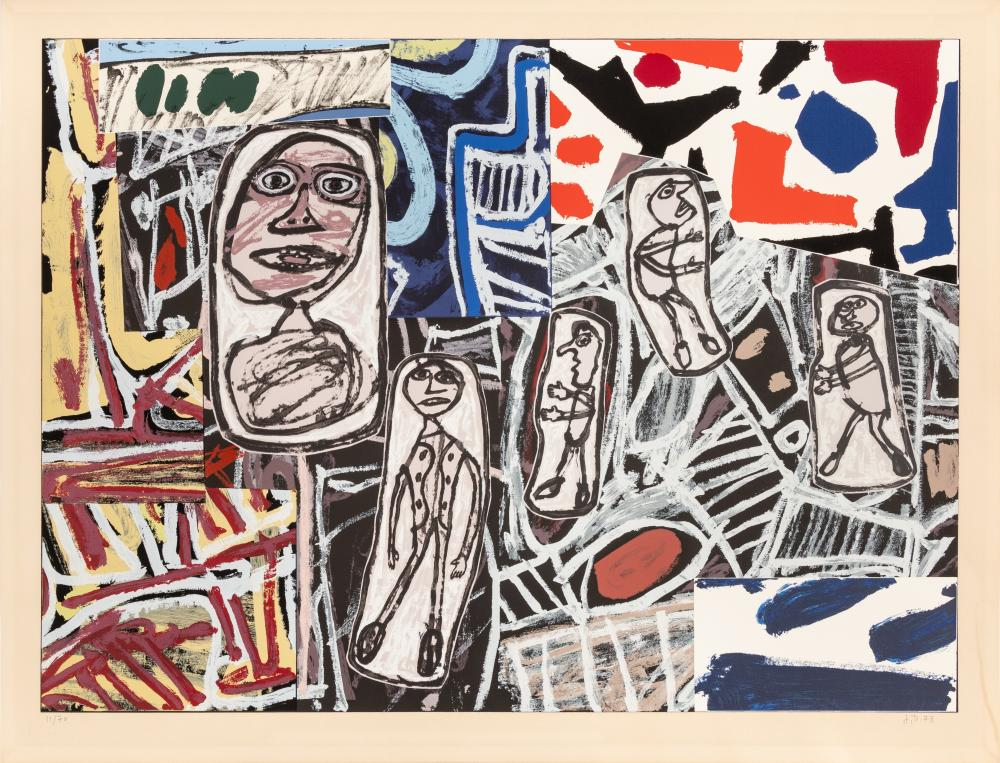
Jean Dubuffet, Faits Memorables III, 1978
Paula Rego
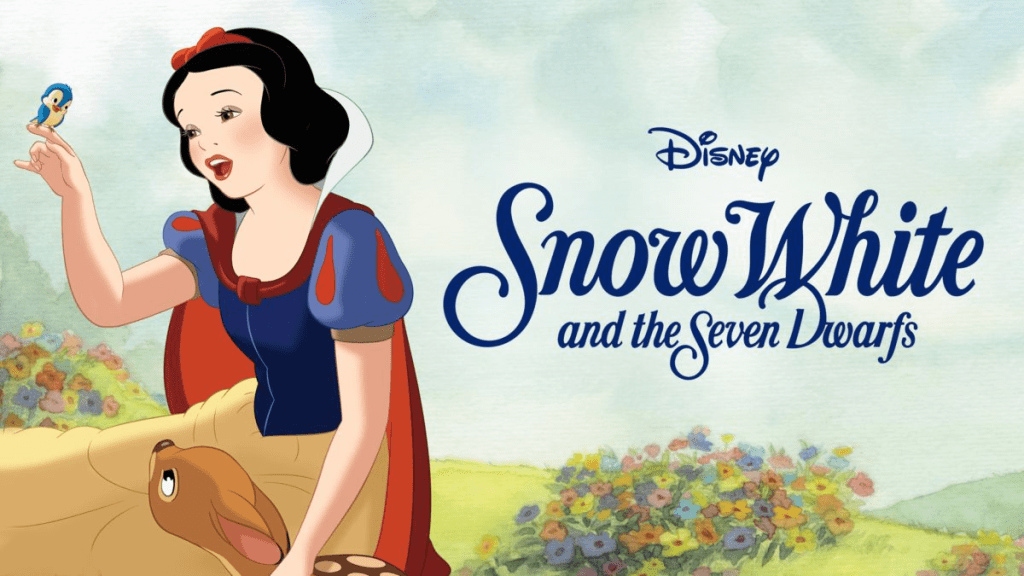
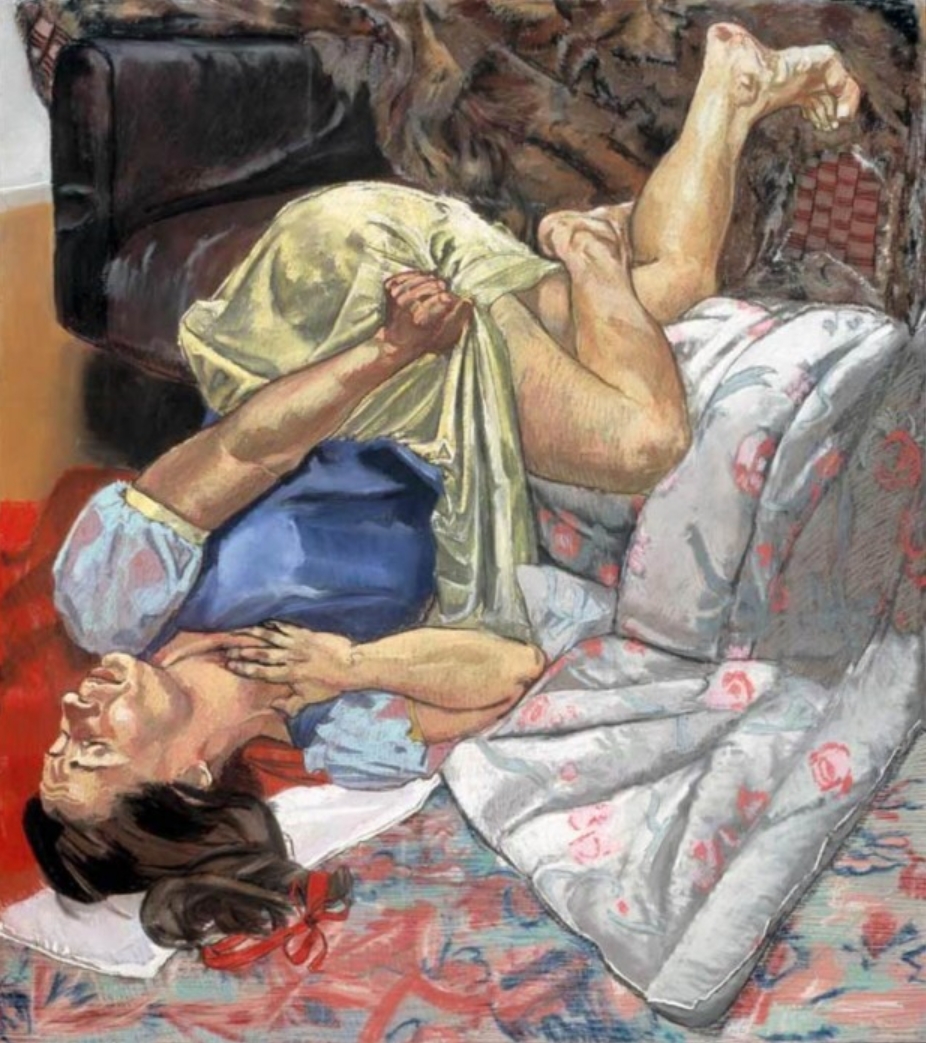
Paula Rego, Snow White Swallows the Poisoned Apple, 1995.
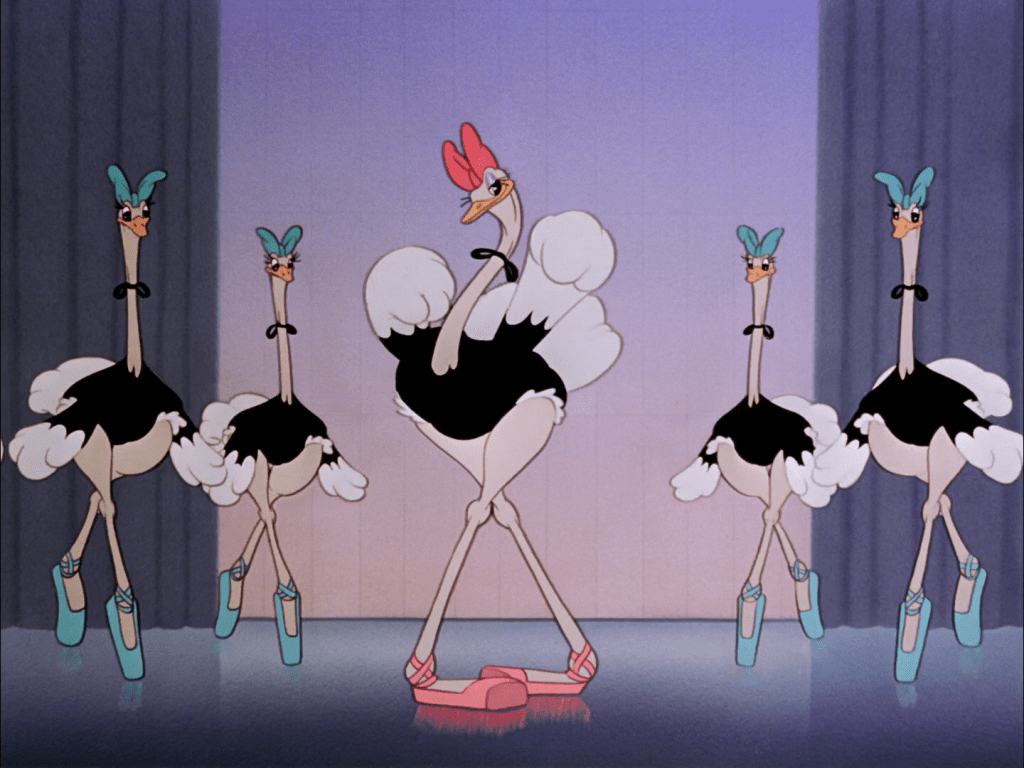
Still from Fantasia, 1940
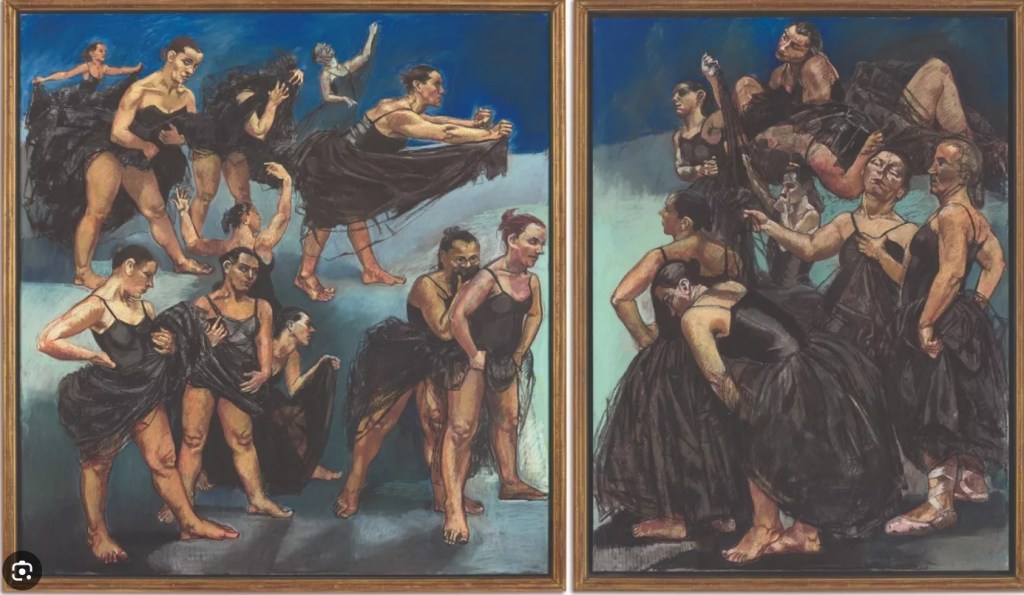
Paula Rego, Dancing Ostriches from Walt Disney’s Fantasia (1995)
Rego was 61 when she painted it and said:
‘the Ostriches couldn’t have been done if I hadn’t been the age I am. A younger woman wouldn’t know what it was like, longing for things that are not gone, because they’re inside one, but are inaccessible.’
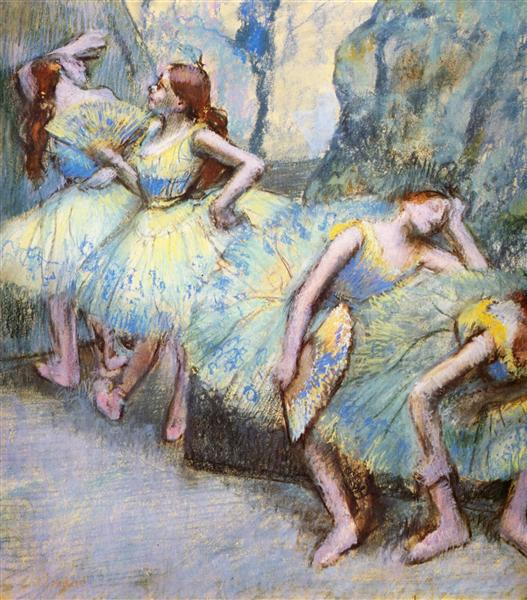
Rego began working almost exclusively in pastel in the 1990s. Return to the more formal figurative work she had rejected as a student once she became artist in residence at the National Gallery. She realised ‘just how good, how incredibly complex and profound’ Old Master paintings could be’. Are the Ostriches a bit like Degas’s pastels of ballerinas? Rego had to give up pastels in old age as too physically demanding and took up making models.
Strange proportions and sometimes dwarves are the hallmark of her figurative work. Influenced by Velasquez in Las Meninas?

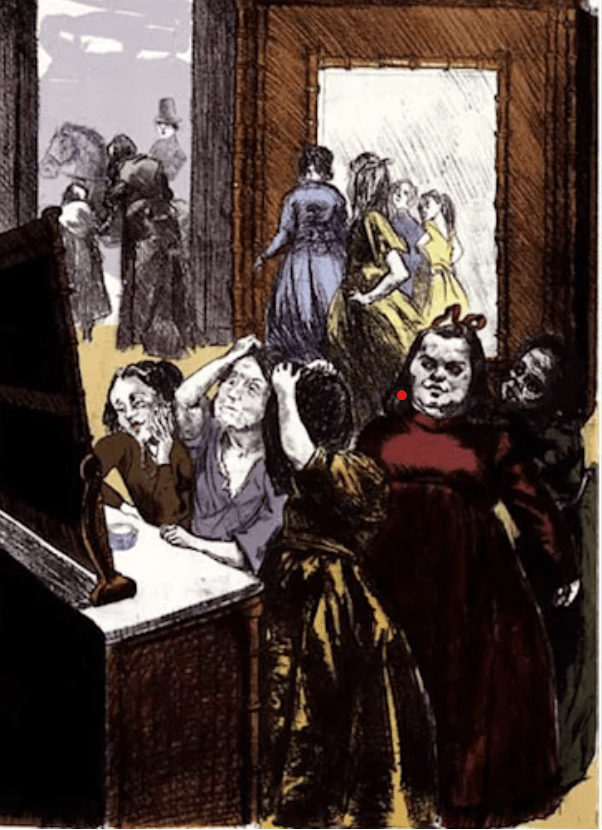
Velasquez, Las Meninas (detail), 1656
Paula Rego, Getting Ready for the Ball, 2002
She used the same model – Lila Nunes, who had also been her husband’s carer – for almost all of her figurative works for 30 years. She has been described as Rego’s alter ego, embodying the emotions and scenarios Rego wanted to portray.
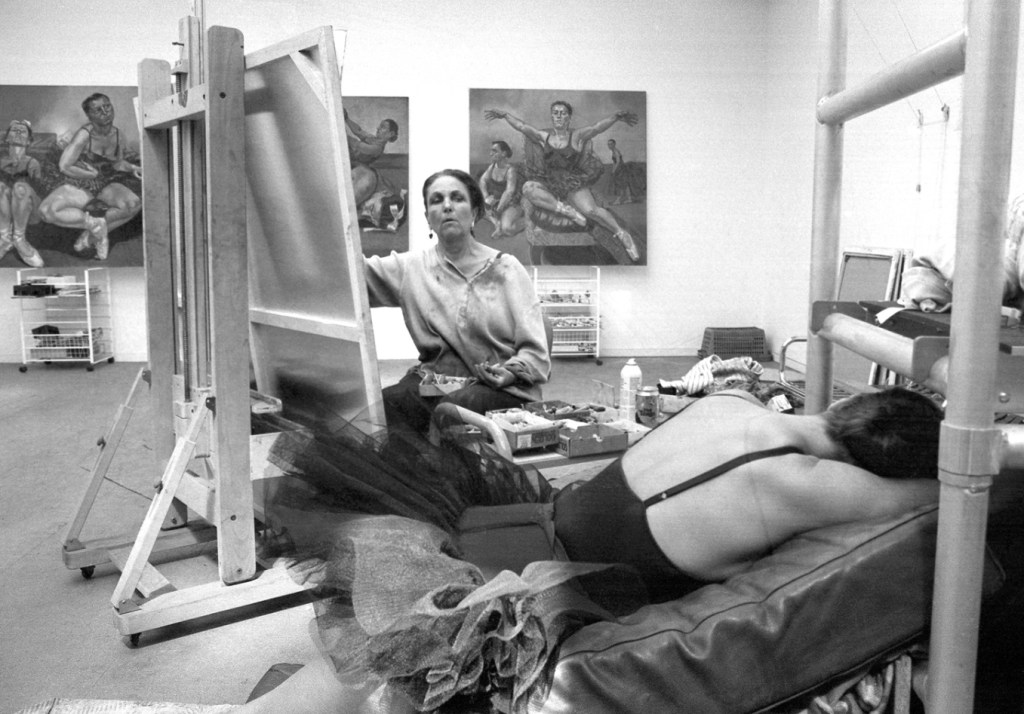
Lila Nunes posing for Dancing Ostriches
Rose Wylie

Rose Wylie, Snowwhite (3) with Duster, 2018
Snow White is both alive, dusting, and dead in her coffin with different hair.

Rose Wylie (1934 – ) Someday her prince will come, 2020
According to Zentrum Paul Klee:
For Wylie, illustrators like Walt Disney are role models because they created autonomous imagery that make no claim to realistic representation. In their cartoon worlds, they were not bound to conventional rules, such as accurate proportions or a convincing sense of distance … Wylie is familiar with simultaneous representation not only from comics but also historical sources, such as cave paintings and early Renaissance frescoes.
As in Rego’s work, clear that Wylie’s figures lack accurate proportions but not so clear she is self-consciously referring to either of these genres (though this is often attributed to her).
Sometimes I get accused of being too cartoon-like. And from my point of view, they’re not cartoon-like at all. I’m simply using everything at my disposal. For instance, if you paint a hot dog, you paint the lines of heat. I use cartoon language, but I also use Renaissance devices of foreshortening and cross-hatching. I put it all in, mix it up … Exaggeration, I don’t actually go for that either. I go for poetic transformation.
https://autre.love/the-levity-issue/rose-wylie-by-juergen-teller
Wylie was elected to the Royal Academy – so hardly an ‘outsider’ but Nicholas Serota, former director of the Tate, redefines ‘outsider’ art in his speech opening Wylie’s exhibition at the Jerwood Gallery, Hastings in 2012 (shown in the film ‘Rose and Roy’). Claims ‘outsider’ merely means outside experience of viewer, not outside of the academy.
at first glance [her work] appears aesthetically simpler but … on closer inspection are revealed to be wittily observed and subtly sophisticated meditations on the nature of visual representation itself. The artist has long been interested in exploring perspectival and compositional strategies other than, and as well as, traditional Renaissance perspective, frequently making numerous iterations of a given theme or motif as a means of advancing her formal investigation.
https://www.goodwoodartfoundation.org/art/artists/rose-wylie/
Wylie herself makes no such claims. In interviews, she agrees with everything an interview says or claims the question isn’t relevant to her eg if asked if she has a favourite colour she says yes, yellow and green. But also black, brown, pink.
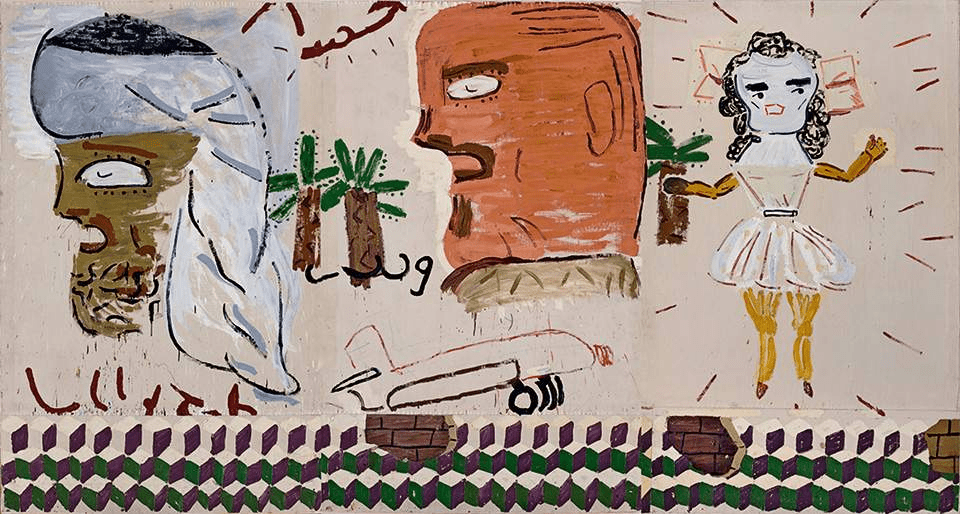
Rose Wylie, Arab and Dancing Girl 2006
Wylie has no time for being PC. Denies being a feminist or that she is popular because old.
She does not use live models but there are a lot of published images of her posing in her ‘chaotic’ studio. She and Rego both sometimes paint on the floor.
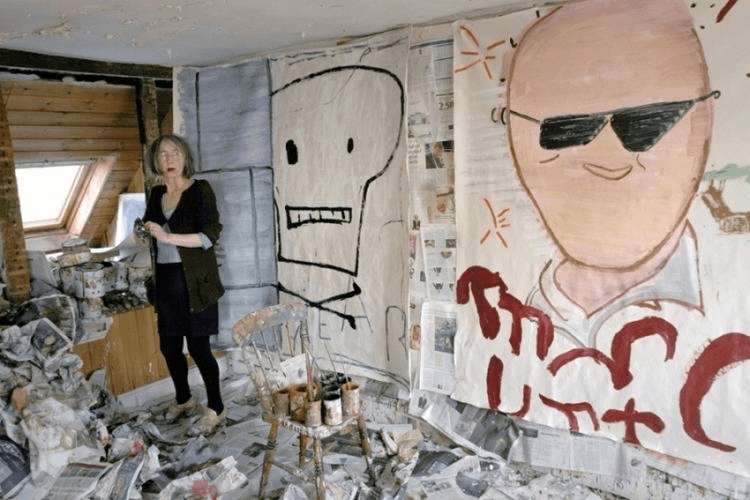
Bringing back to my own practice. I couldn’t work like Wylie, aesthetics matter. Rego’s very physical work.
Asked the question How important, or not, is it for you that people looking at your paintings understand the references? Or can they take away their own new meanings from them?
It doesn’t matter at all. I think it can be enriching for the audience if they do see, or interpret it in some sort of way, but it need not necessarily be what I intend. I think it should be open. But it’s quite nice if they’ve seen films, like For A Few Dollars More (1965) or Blazing Saddles (1974).
Are these references of the same type as folk/fairy tales?
References
https://www.tate.org.uk/research/tate-papers/02/contemporary-art-and-the-role-of-interpretation
Rose Wylie
https://www.frieze.com/article/rose-wylie
Abstraction and Decoration – In Focus | Tate https://share.google/4wUlocx5b6avjuMvi
Who is Britain’s hottest new artist? A 76-year-old called Rose Wylie | Art | The Guardian https://share.google/wIk49EfYAak4TkDOR
https://autre.love/the-levity-issue/rose-wylie-by-juergen-teller
An artist’s dream world | Tate https://share.google/hSWhgxabJMGZ4g6p7
Paula Rego | Tate Britain https://share.google/UsLhH3HlbubkTZzPM
Paula Rego’s Jane Eyre – Goldmark https://share.google/N8YiXBd8iGESduyri
Schoolroom (Jane Eyre Series) » Charles Nodrum Gallery https://share.google/Ma1QTnQUdDj24jI4R
https://share.google/PlREFgoSilML8bE4q
https://www.bbc.co.uk/culture/article/20210709-paula-rego-is-this-britains-greatest-living-artist
https://www.lrb.co.uk/the-paper/v43/n19/gaby-wood/at-tate-britain
https://www.lrb.co.uk/the-paper/v26/n23/peter-campbell/at-tate-britain
 Creative Practice